
Federal employee forced to repay payroll error as Canada prepares Dayforce rollout
A long-serving federal employee says she has become a “collateral casualty” of Canada’s ongoing payroll crisis, just as the government prepares to test a replacement system intended to fix a decade of errors.
Kristen Ouellette, a manager at Public Services and Procurement Canada (PSPC), says hundreds of dollars are now being deducted from each of her paycheques due to what she describes as a long-standing administrative mistake—one she insists was never hers to begin with.

A system in transition — and under pressure
The federal government is preparing to transition from the troubled Phoenix pay system to a new platform, Dayforce, with pilot testing expected to begin later this year. PSPC is one of three departments selected for the initial rollout, alongside Shared Services Canada and the Canadian Nuclear Safety Commission.
But the transition depends on departments resolving their backlog of payroll issues first.
According to internal figures, PSPC has been working through approximately 19,900 priority and backlog cases, with roughly 78% completed as of mid-March. Across the federal system, however, more than 216,000 pay-related cases remain unresolved—nearly a decade after Phoenix was first introduced in 2016.
A mistake resurfaces years later
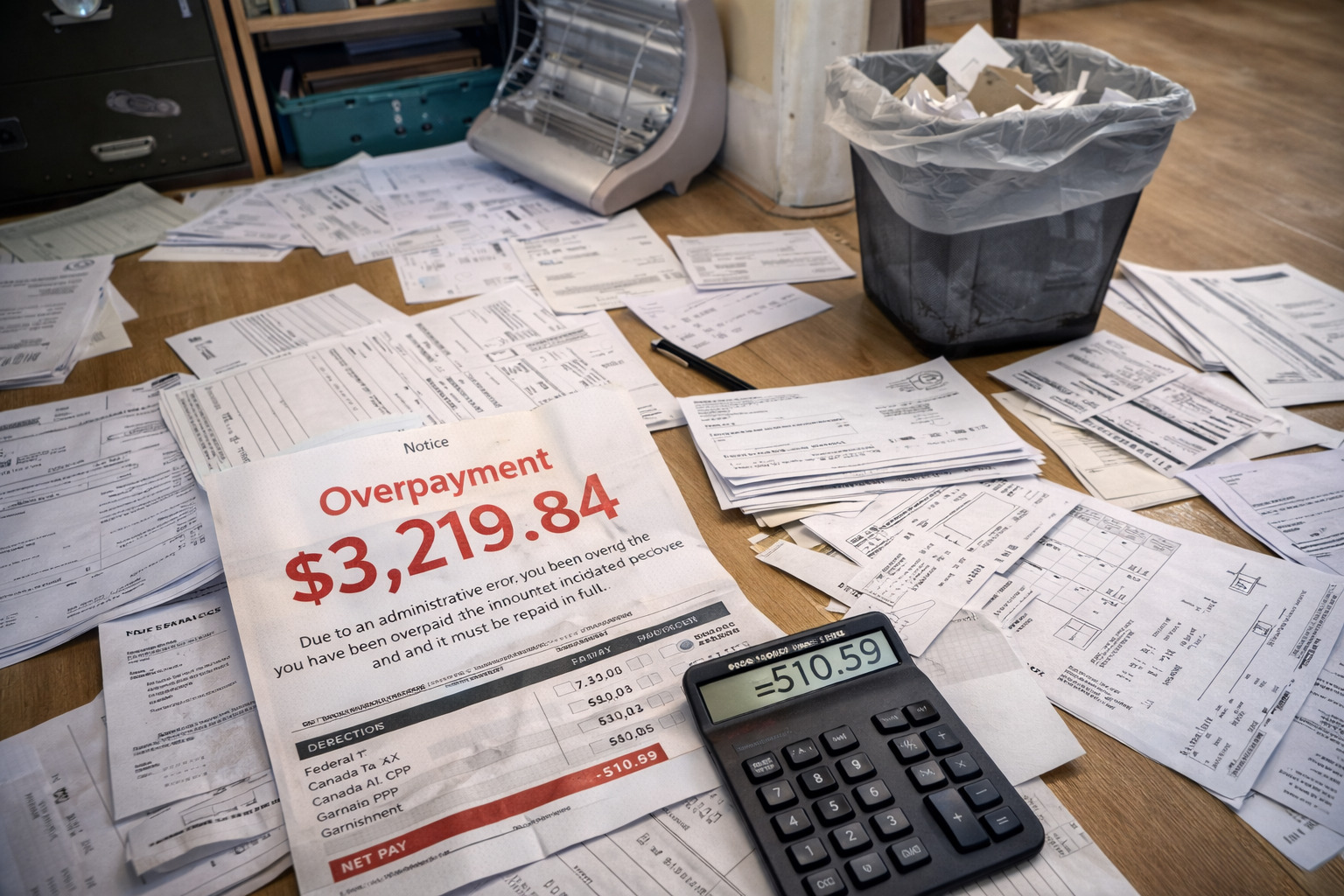
Ouellette says her situation began unexpectedly in January, when she received a notice claiming she had been overpaid $3,219.84.
“I was shocked,” she said. “I had never received an overpayment before.”
After reviewing her file, she discovered the issue traced back to 2020, when a “zero-balance cheque” had been incorrectly entered into her payroll record during a recalculation tied to a temporary higher-level position she had held.
The error, she says, went unnoticed for years—until her file was reopened as part of the government’s effort to clean up backlog cases ahead of the Dayforce rollout.
Paying for a system failure in Canada payroll system
According to PSPC, the issue originated from incorrect employment insurance contributions that were remitted to the Canada Revenue Agency (CRA), creating an internal accounting gap within the federal payroll system.
Instead of resolving the discrepancy at the institutional level—through inter-agency adjustment or recovery from CRA—the department moved to reclaim the full amount directly from the employee. In practice, this converts a government payroll error into a personal financial obligation.
Since this month, approximately $510 is being deducted from each paycheque, effectively turning a historical administrative fault into an ongoing salary reduction. Cases like this highlight a recurring risk within the Canada payroll system Phoenix issues, where backlog corrections translate into immediate financial pressure for employees.
“They’re asking me to fix a system error I didn’t create,” Ouellette said. “It feels like I’m paying for their transition.”
Beyond the individual impact, the situation raises broader concerns around federal payroll mistakes Canada, salary deductions government employees, and the handling of legacy errors during the Phoenix to Dayforce transition. Instead of isolating and correcting systemic failures, the resolution mechanism appears to redistribute their cost—shifting accountability from the system to the individual.No recourse, no resolution
Ouellette was advised to request a reassessment from CRA to recover the overpaid contributions. However, the agency confirmed that the statutory three-year window for such claims had expired, leaving her unable to reclaim the funds.
In internal correspondence reviewed by CBC News, a PSPC compensation advisor acknowledged the situation “seems unfair,” but said the department could not override CRA policy.
Ouellette says repeated attempts to escalate her case have gone unanswered.
“You start questioning everything,” she said. “Why am I still here? Does any of this matter to them?”
Broader concerns around Dayforce rollout
The case comes amid growing scrutiny of the government’s timeline for implementing Dayforce.
In a recent report, Auditor General Karen Hogan warned that unresolved Phoenix issues could carry over into the new system if not fully addressed beforehand. She also raised concerns about prioritizing pilot departments while significant backlogs persist elsewhere.
Just days after the report was released, PSPC’s senior official responsible for payroll modernization announced his resignation, adding further uncertainty to the transition process.
A systemic pattern, not an isolated case
The Professional Institute of the Public Service of Canada (PIPSC), representing Ouellette, frames the situation as part of a broader structural issue rather than an individual anomaly.
Union president Sean O’Reilly points to a recurring mechanism: administrative errors are identified retroactively, but the financial burden is assigned to employees instead of being absorbed or corrected within the system that generated them. In practice, this shifts institutional risk onto individuals who have no control over payroll processing.
He also raises a procedural concern tied to the transition itself. Resolving backlog cases is being treated as a technical prerequisite for launching Dayforce, yet the way these cases are handled suggests speed is being prioritized over fairness.
The underlying question is not only about this case, but about continuity of failure. If unresolved discrepancies are closed through recovery rather than correction, the transition risks formalizing flawed outcomes instead of eliminating them.
From the union’s perspective, this is not simply about compensation errors. It is about whether a new system will reset accountability — or inherit the same logic under a different name.A system still searching for trust
Nearly ten years after Phoenix was introduced, its consequences continue to affect thousands of federal workers. While the government frames Dayforce as a reset, cases like Ouellette’s highlight a deeper issue: unresolved errors are not just technical—they are personal.
And until accountability matches ambition, the promise of a new system risks repeating the same old failures under a different name.

Daniel Hughes
Sustainability & Policy Correspondent
Daniel is interested in how environmental policy translates into real urban change. He specializes in sustainable mobility, climate-focused city planning, and the political frameworks behind transport systems. His writing brings together data, policy analysis, and on-the-ground impact, offering a clear view of how sustainability initiatives affect everyday urban life.
Advertise With Toronto Union 24
Reach over 500,000 engaged Canadian readers monthly. Premium placements available for Q2 2026.
Learn More Liam Carter
  Aila Kenuak