
Casino Payment Methods in Canada Explained
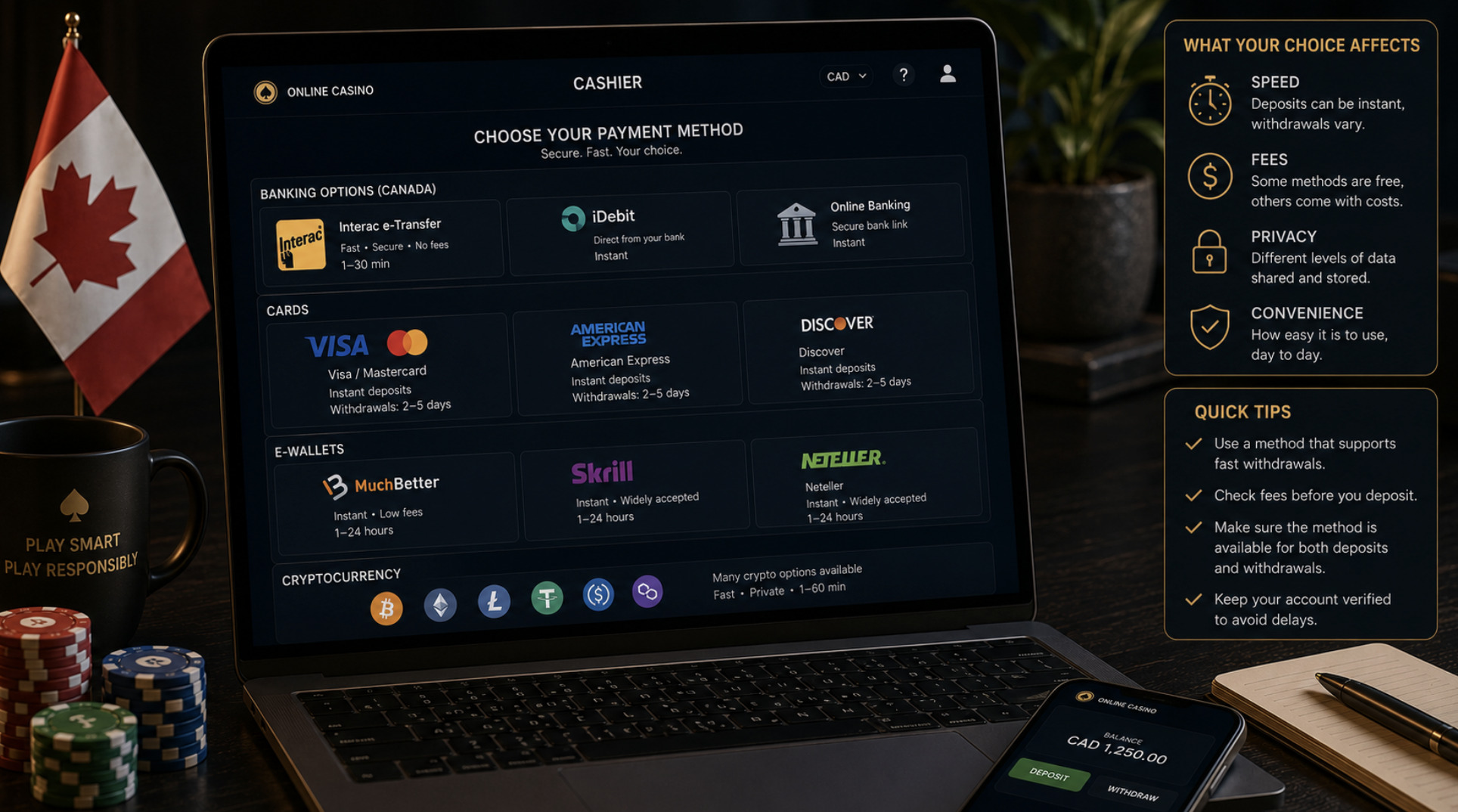
The first real decision a Canadian online casino player makes is not which game to play but how to move money in and out. It is easy to treat this as a formality and click whatever the cashier defaults to, yet the payment method you choose quietly shapes almost everything that follows: how fast you can deposit and, more importantly, withdraw; whether you pay any fees; how much privacy you keep; and how smooth the whole experience feels. Canada happens to have one of the richer payment landscapes in the world, with a distinctive home-grown system sitting alongside cards, e-wallets and cryptocurrency. Understanding the options, and the trade-offs each carries, is the difference between a payment method that fits how you play and one that frustrates you every time you try to cash out.
What to weigh before choosing
Before looking at the methods themselves, it helps to know the four factors that actually distinguish them. Speed is the most obvious, and it matters most on the way out — some methods return your money in hours, others in days. Fees vary: some methods are free, while others carry a small charge on the operator's or the provider's side. Limits differ too, with each method and operator setting minimum and maximum amounts for deposits and withdrawals. And privacy separates the options as well, since some methods keep your banking details away from the casino while others do not. Almost every meaningful difference between payment methods comes down to where they sit on these four axes, so keeping them in mind turns a confusing menu into a simple comparison.
The methods at a glance
MethodDeposit speedWithdrawal speedPrivacyBest forInterac e-TransferFastModerateHigh (no card details shared)Canadians who want trusted, bank-based paymentsDebit/credit cardInstantSlower (business days)LowerSimplicity and familiarityE-walletsInstantFast (often hours)HighQuick withdrawals and added privacyCryptocurrencyFastFast (often hours)HighSpeed and independence from banksPrepaid / vouchersInstantNot usually for withdrawalHigh (no bank link)Budget control on deposits
The table makes the pattern clear: digital methods lead on withdrawal speed, bank-based methods lead on trust, and each has a natural "best for." The sections below unpack them.
Interac and bank-based methods
For Canadian players, Interac is the standout. Interac e-Transfer lets money move directly between bank accounts using nothing more than an email address, and its ubiquity in Canada makes it a natural fit for online payments. It is trusted, widely supported and keeps card details out of the transaction, which many players value highly. Related bank-based options include direct online bank transfers, which draw straight from an account and suit players who prefer to deal with their bank rather than a card or a third party.
The strength of bank-based methods is trust and directness: you are dealing with the banking system you already rely on, and your card details never enter the picture. The trade-off is that withdrawals through them can be slower than digital wallets, since they run on traditional banking rails that settle on business days. For a great many Canadian players, that trade-off is more than acceptable, which is why Interac has become the default for so many.
Cards
Debit and credit cards remain among the most familiar ways to deposit, and their appeal is simplicity — nearly everyone has one, and using it requires no new account. Deposits are typically instant, and there is nothing to set up. The considerations sit on the other side of the transaction. Card withdrawals often take longer than e-wallets, running through banking systems that process over business days, and some players would rather not expose card details to a gambling site or put gambling transactions on a credit card at all. For deposits, cards are convenient and quick; for fast payouts, they are rarely the speediest route, which is why many players deposit by card but withdraw another way where possible.
E-wallets
E-wallets have become a favourite for online casino payments because they combine speed with a useful layer of separation. A wallet sits between your bank or card and the casino, so the operator never sees your underlying banking details, and withdrawals to a wallet are often among the fastest available, frequently arriving within hours rather than days. The trade-off is an extra account to set up and fund, and occasionally a small fee, but for players who value quick payouts and added privacy, e-wallets are often the sweet spot. When comparing platforms, the range and quality of supported wallets is worth checking — sites such as Vipluck and other regulated Canadian operators typically list their supported methods in the cashier or on a payments page, so you can confirm your preferred wallet is available before committing.
Cryptocurrency
Cryptocurrency is the newer, more specialised option. For a segment of Canadian players, digital currencies offer fast withdrawals, a degree of privacy and independence from traditional banking. The trade-offs are real and worth stating plainly: crypto involves a learning curve, its value can be volatile, and it is not for everyone. But where it is supported and genuinely understood, it is often among the quickest ways to move money in and out, which is why it has carved out a steady niche among more experienced players. Anyone considering it should be comfortable with how it works before using it, rather than treating it as just another button in the cashier.
Prepaid cards and vouchers
A less discussed but useful category is prepaid cards and vouchers. These let a player deposit a fixed, pre-loaded amount without linking a bank account or card directly to the casino, which appeals to those who want tight control over spending or an extra layer of separation. The main limitation is that they are generally a deposit-only method — you usually cannot withdraw back to a voucher — so they pair naturally with a separate withdrawal method. For budget-minded players who like to decide in advance exactly how much they are willing to load, they are a neat tool.
Matching the method to your priorities
With the options laid out, the right choice becomes a question of priorities rather than a search for a single "best" method. If speed of withdrawal matters most to you, e-wallets and cryptocurrency lead the field. If trust and familiarity matter most, Interac and cards are hard to beat. If privacy is your priority, methods that keep your banking details away from the casino — Interac, e-wallets, crypto and vouchers — are preferable to handing over a card directly. And if controlling your spending is the goal, a prepaid method or a card paired with deposit limits does the job. There is genuinely no universal best; there is only the method that fits how you want to play, which is why understanding the trade-offs matters more than chasing whatever a list ranks first.
Deposit and withdrawal compatibility
One practical trap deserves its own mention: not every method that accepts deposits can also process withdrawals. It is entirely possible to deposit with one method only to discover, at cash-out time, that you must withdraw another way. Before depositing, check that your preferred method works in both directions, or at least that a suitable withdrawal option is available to you. This simple check avoids the common frustration of being funnelled onto a slower payout method than you expected, and it is one of the easiest mistakes to prevent.
Safety and the role of regulation
Whatever method you choose, dealing with licensed, regulated operators is the foundation of safe payments. Regulated platforms are bound by standards around handling money, protecting personal data and honouring withdrawals, and they secure transactions with encryption so your details are protected in transit. In regulated Canadian markets, provincial oversight adds a further layer of accountability. The crucial point is that a payment method is only ever as safe as the platform behind it: the most secure wallet in the world offers little protection at an unregulated, untrustworthy site. Choosing a reputable, regulated operator is therefore as important as choosing the right way to pay — the two decisions work together.
Understanding fees, limits and the fine print
Two details that rarely get enough attention are fees and limits, yet both can quietly shape your experience. On fees, the picture varies: many deposit and withdrawal methods are free, but some carry a small charge, whether from the payment provider or the operator, and occasionally a currency-conversion cost can apply if a method processes in a currency other than Canadian dollars. It is worth a quick look at the cashier before depositing, since a method that is free at one operator may carry a fee at another. None of these charges is usually large, but knowing about them in advance prevents small surprises.
Limits are the other piece of the fine print. Every method and operator sets a minimum you can deposit or withdraw, along with daily, weekly or monthly maximums, and these differ considerably. For most players the limits are generous enough never to notice, but they matter in two situations: when depositing very small amounts, which may fall below a minimum, and when withdrawing a large win, which may exceed a periodic cap and be paid in instalments. Reading the limits for your chosen method before you play, rather than discovering them at withdrawal time, is a simple habit that avoids the most common payment frustrations. The terms and the cashier are where these numbers live, and a two-minute read is usually all it takes.
Payments on mobile in Canada
Because most Canadian players now access online casinos on their phones, it is worth noting how these methods behave on mobile. The good news is that the major options are all built for it. E-wallets and banking apps are designed mobile-first, so paying from a phone is often faster and smoother than on a desktop, frequently with a single tap and biometric confirmation replacing the need to type card details. Interac e-Transfer, being tied to banking apps most people already have on their phones, is especially natural on mobile.
The practical upshot is that the method you choose should also suit how you actually play. If you are primarily a mobile player, a method that confirms with a fingerprint or a face scan and requires no fiddly card entry will make every deposit quicker and every session smoother. Checking that your preferred method works cleanly in the operator's mobile cashier, before committing, ensures the payment experience is as effortless on a phone as the rest of the platform.
Frequently asked questions
What is the best payment method for Canadian online casinos? There is no single best method. Interac and cards win on trust and familiarity; e-wallets and cryptocurrency win on withdrawal speed and privacy; prepaid methods help with budgeting. The right choice depends on whether you prioritise speed, fees, privacy or control.
Is Interac safe for online payments? Yes. Interac is a trusted, widely used Canadian system that moves money directly between bank accounts without exposing your card details, which is a large part of why it is so popular for online payments.
Why can't I withdraw using the method I deposited with? Some methods support deposits but not withdrawals. Always confirm your preferred method works both ways before depositing, so you are not forced onto a slower option to cash out.
Which method has the fastest withdrawals? E-wallets and cryptocurrency are usually fastest, often within hours, because they move money digitally. Cards and bank transfers typically take a few business days.
Do Canadian casino payments carry fees? It depends on the method and the operator. Some are free; others carry a small charge on the provider's or operator's side. Checking the cashier or payments page before depositing shows any fees that apply.

Daniel Hughes
Sustainability & Policy Correspondent
Daniel is interested in how environmental policy translates into real urban change. He specializes in sustainable mobility, climate-focused city planning, and the political frameworks behind transport systems. His writing brings together data, policy analysis, and on-the-ground impact, offering a clear view of how sustainability initiatives affect everyday urban life.
Advertise With Toronto Union 24
Reach over 500,000 engaged Canadian readers monthly. Premium placements available for Q2 2026.
Learn More Liam Carter